
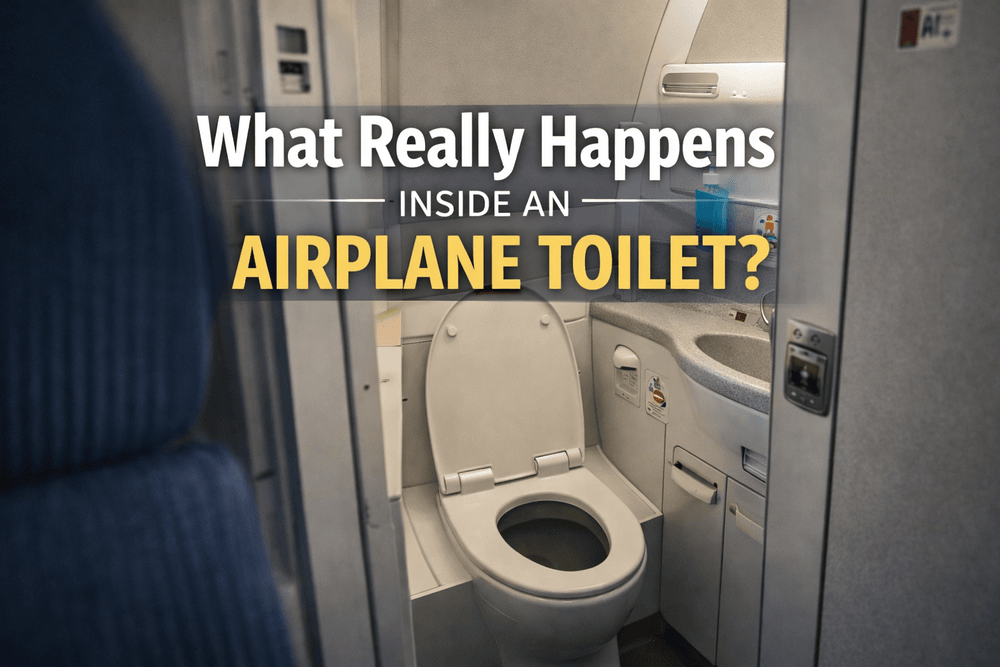
 What Really Happens Inside an Airplane Toilet?
It’s small.
It’s loud.
And somehow, it’s one of the most mysterious parts of flying.
Almost every passenger wonders the same thing at some point during a flight:
How does an airplane toilet actually work?
Here’s the clear, no-nonsense explanation—minus the myths, drama, and internet nonsense.
That sudden whoosh isn’t pressure—or danger.
Airplane toilets use a vacuum system, not water pressure. When you flush:
The loud sound comes from air rushing in to equalize pressure.
It’s normal. It’s expected. And it’s completely safe.
No, waste is not released into the sky.
All waste goes into a sealed onboard tank, which:
This system is strictly regulated and monitored—just like other critical aircraft systems.
Yes—with common sense.
The toilet itself is safe at altitude. The real risk comes from
unexpected turbulence, not the toilet system.
That’s why cabin crew may restrict movement during turbulence—not because the toilet is unsafe,
but because balance can be lost.
Here’s the honest answer.
During longer stops or overnight layovers:
On quick turnarounds, cleaning focuses on hygiene and usability,
not perfection. That’s why washing your hands properly always matters.
Because aircraft design is all about trade-offs.
Every extra centimeter means more weight, higher fuel burn, and fewer seats.
Toilets are designed to be:
Not spacious—but efficient.
Toilets matter more than passengers realize.
One unserviceable toilet can delay a flight, limit passenger capacity,
or even trigger an aircraft swap—especially on long-haul routes.
That’s why crews report even minor toilet issues immediately.
Not glamorous—but operationally critical.
Airplane toilets aren’t mysterious or dangerous.
They’re engineered, regulated, maintained, and designed to work safely at 35,000 feet.
Loud? Yes.
Luxurious? No.
Reliable? Absolutely.
They use a vacuum system that pulls waste into a sealed tank using minimal water.
The toilet system is safe, but passengers should remain seated during turbulence to avoid injury.
Waste is stored in sealed onboard tanks and emptied only after the aircraft lands.
They are cleaned between flights, with deeper cleaning during longer stops or overnight layovers.
The loud flush is caused by air rushing in to equalize pressure when the vacuum system activates.

Seafarer and Family Man
I'm Dexter— a seafarer by profession, a traveler by passion, and a homebody by choice.
Leave A Comment