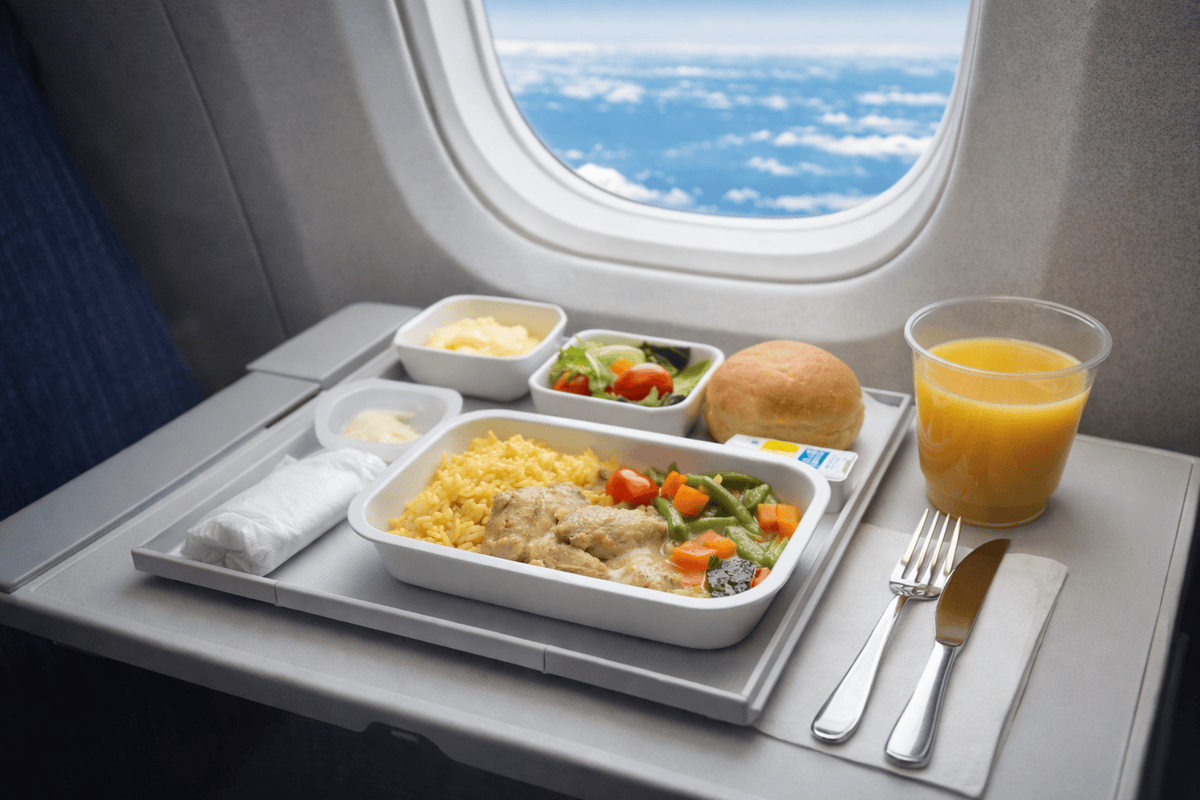
Airline meals are one of the most talked-about—and most misunderstood—parts of flying.
Some passengers say airline food tastes bland. Others are surprised it’s actually decent.
But very few people truly understand how airline meals are prepared, stored, and served onboard aircraft at 35,000 feet.
Here’s what really happens to your in-flight meal long before it reaches your tray table.
This surprises many first-time flyers.
Airline meals—also known as in-flight meals or airplane meals—are prepared on the ground by specialized
aircraft catering facilities, not cooked in the air.
These airline catering services prepare thousands of meals daily under strict food safety standards.
Once cooked, meals are:
Everything follows a standardized process. Nothing is improvised onboard.
Airline catering operates on carefully planned schedules.
Most airline meals are prepared several hours before departure—sometimes earlier for long-haul flights.
This allows enough time for:
Once loaded, meals remain chilled until service begins.
Inside the aircraft, airline meals are stored in dedicated galley compartments and refrigeration units
within the aircraft galley.
These onboard catering systems are designed to:
Just like other aircraft systems, galley equipment is certified and regularly checked.
Aircraft galleys don’t work like home kitchens.
Airline meals are reheated onboard using specialized aircraft ovens designed for safe operation at altitude.
These ovens focus on:
Cabin crew follow precise instructions to ensure airline food is reheated safely and consistently.
Airline meals are engineered for reliability—not presentation.
Design priorities for in-flight food include:
This is why sauces, stews, rice dishes, and pasta are common in airline meal service—they reheat far better
than delicate foods.
Catering delays can impact an entire flight.
If airline meals are not loaded on time:
On long-haul flights, catering is an operational requirement—not a luxury.
For cabin crew, airline meal service is a carefully timed operation.
They manage heating schedules, special meal requests, and service timing while coordinating with flight
operations. When everything runs smoothly, passengers rarely notice how much planning is involved.
Airline meals aren’t restaurant food—and they’re not meant to be.
They are designed to be safe, consistent, and reliable under strict time, space, and safety constraints.
The next time an airline meal lands on your tray table, you’ll know it’s the result of logistics,
engineering, and careful planning—not guesswork.
Airline meals are cooked on the ground, chilled, and later reheated onboard the aircraft.
Most airline meals are prepared several hours before departure, especially for long-haul flights.
They follow strict food safety standards, including temperature control and hygienic handling.
Airline meals are reheated onboard using specialized aircraft ovens designed for use at altitude.

Seafarer and Family Man
I'm Dexter— a seafarer by profession, a traveler by passion, and a homebody by choice.