

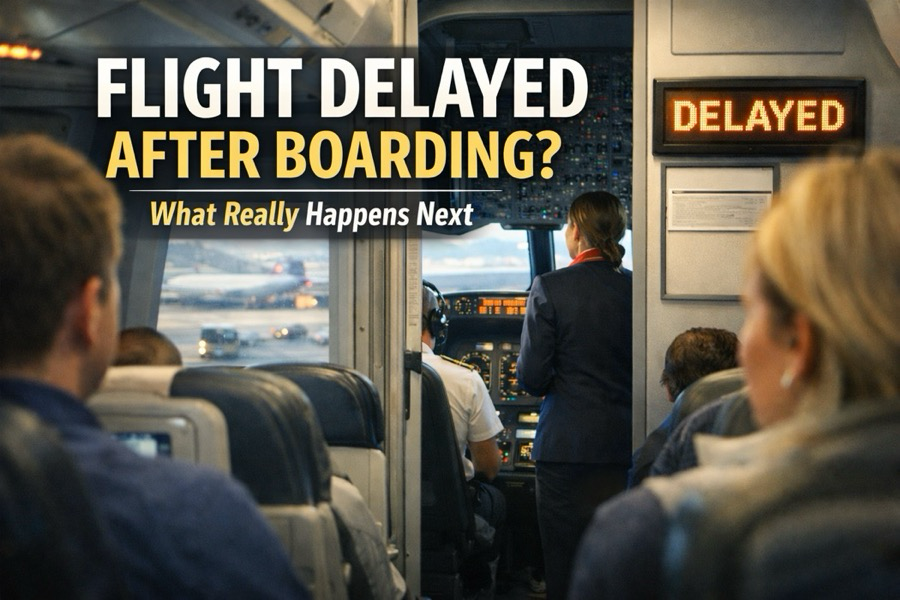
You’re already seated.
Seatbelt on.
Cabin doors closed.
Then… nothing.
No pushback. No engine start. Just waiting.
A delay after boarding feels frustrating—but from the flight deck, it usually means important checks are still happening. Here’s what’s really going on.
⸻
A Post-Boarding Delay Is Never Random
Once passengers are onboard, the goal is to depart as soon as safely possible.
If the aircraft isn’t moving, it’s because:
• Something changed at the last minute, or
• A required clearance isn’t complete yet
In aviation, no step is skipped just to stay on schedule.
⸻
Final Paperwork Isn’t Complete
Before pushback, pilots must confirm:
• Final passenger and baggage numbers
• Aircraft weight and balance
• Fuel figures
• Updated weather and routing
If one number changes, everything is rechecked.
⸻
Weather Changed—Somewhere
Weather doesn’t only matter at departure.
A storm near:
• Your destination
• An alternate airport
• En route airspace
can require new fuel calculations or route approval—even if the sky outside looks fine.
⸻
A Small Technical Check
Most post-boarding technical issues are minor:
• A sensor check
• A system reset
• An indicator verification
Minor doesn’t mean ignorable.
If it’s flagged, it’s checked—no exceptions.
⸻
Crew Duty Limits
Pilots and cabin crew operate under strict time limits.
If a limit is reached:
• The aircraft waits, or
• A replacement crew is arranged
Regulations don’t bend—even if everyone is ready.
⸻
Air Traffic Control Restrictions
Sometimes the aircraft is ready—but the airspace isn’t.
ATC may impose:
• Slot delays
• Flow control
• Ground holds
You’re waiting for permission to go, not for the aircraft.
⸻
Pilots avoid giving guesses.
Information changes fast, and a “10-minute delay” that turns into 40 only causes more frustration. Updates usually come once details are confirmed.
Silence doesn’t mean nothing is happening—it means coordination is ongoing.
⸻
Actually, no.
Most of the time, it means:
• Systems are being double-checked
• Procedures are being followed
• Safety margins are being protected
The delay itself is often proof the system is working.
⸻
Deplaning isn’t simple.
It requires:
• Gate availability
• Ground crew coordination
• Security and baggage tracking
• Reboarding later
If the issue is likely short, staying onboard is usually faster overall.
⸻
For pilots, a post-boarding delay means:
• Continuous coordination with dispatch and ATC
• Rechecking data
• Confirming the safest next step
No rushing.
No assumptions.
Just disciplined aviation.
⸻
If your flight is delayed after boarding, remember this:
If the aircraft hasn’t moved yet, someone is making sure it’s truly ready to fly.
And that’s exactly how aviation should work.
Flights may be delayed after boarding due to last-minute paperwork, weather updates,
minor technical checks, crew duty limits, or air traffic control restrictions.
Yes. It is common and usually means required safety or operational checks are still
being completed before departure.
No. Most post-boarding delays are precautionary and indicate that aviation safety
procedures are being followed correctly.
Information can change quickly. Pilots usually wait for confirmed details before
giving updates to avoid inaccurate time estimates.
Deplaning requires gate availability, ground crew coordination, and reboarding later.
If the delay is expected to be short, staying onboard is usually faster overall.
Yes. Weather at the destination, alternate airports, or along the route can affect
departure even when conditions at the origin airport appear clear.

Seafarer and Family Man
I'm Dexter— a seafarer by profession, a traveler by passion, and a homebody by choice.
Leave A Comment